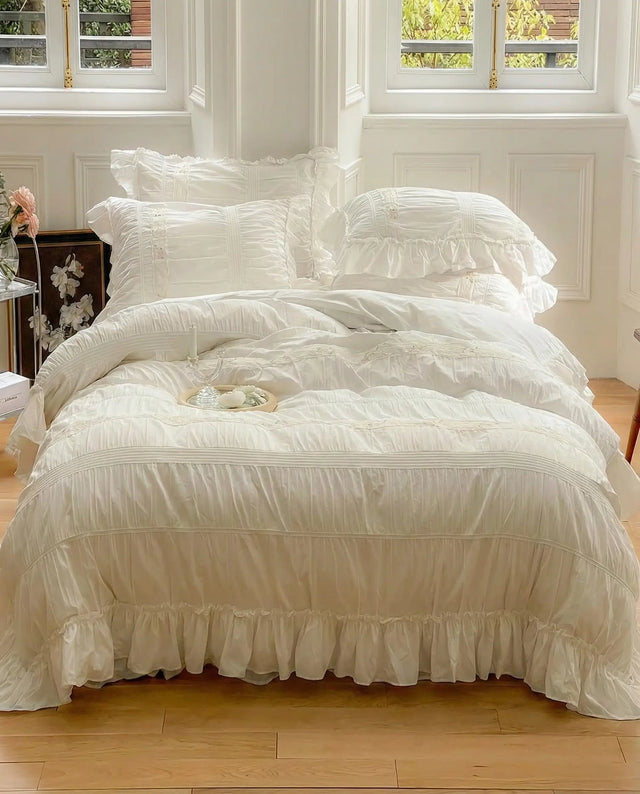
Ruched vs Ruffle Bedding: What's the Difference?
Ruched and ruffled bedding often get mentioned together, and it's easy to see why. Both use gathered fabric to add softness and texture to a bed. But they're made differently, and they look quite different once the bed is made.
Here's how to tell them apart, and how to choose the one that suits your room.
The short answer: ruching gathers the fabric across the surface of the duvet cover, so the whole bed has texture. Ruffles are strips of gathered fabric sewn along the edges, so the texture frames the bed instead of covering it.
What is ruched bedding?
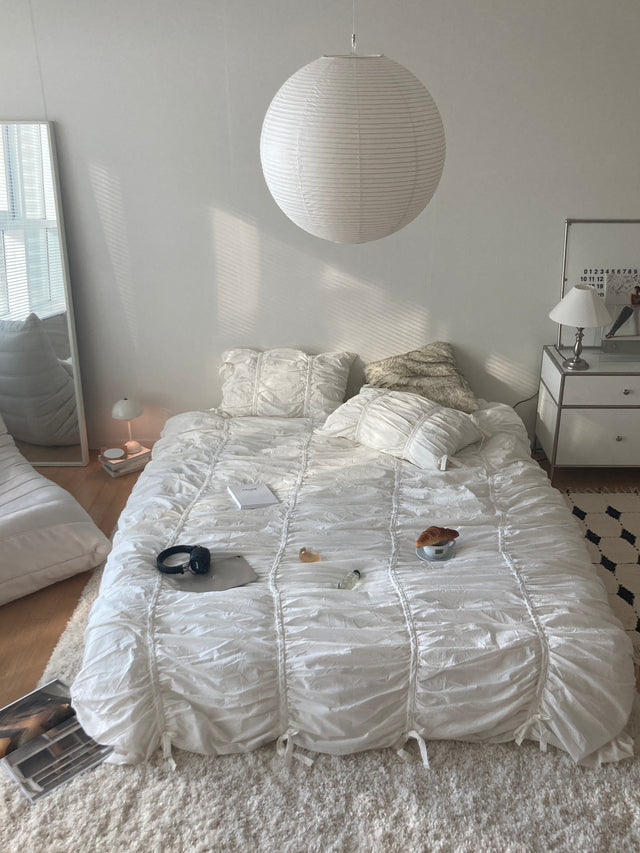
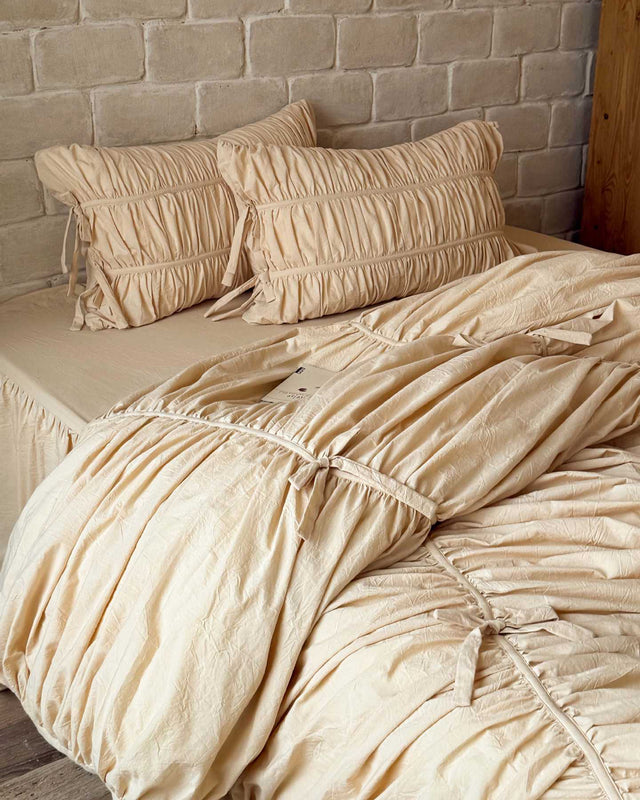
Ruching is fabric that has been gathered along a line of stitching so it falls into soft, rippled folds. On a duvet cover, those gathers run across the top in rows or channels, and the texture covers the whole surface.
The effect is soft and dimensional, even on a plain white bed. Because the texture is part of the fabric, ruched bedding also hides everyday creases well, so the bed looks made even when it isn't perfectly smoothed.

Ruching also changes how a bed feels to look at. Where a flat cover reflects light evenly, the folds of a ruched cover catch light and shadow, which is why even an all-white ruched bed never looks plain.
Our ruched sets show how different ruching can look:
- The Classic White Ruched Duvet Cover Set keeps it simple, with ruching gathered along the length of an all-white cover.
- The Dream Drape Ruched Duvet Cover Set adds lace trim and embroidered florals on ivory.
- The Royal Ruched Duvet Cover Set has ruched channels finished with tied cotton bows, plus ruched pillowcases and a ruffled bed skirt.
What is ruffled bedding?
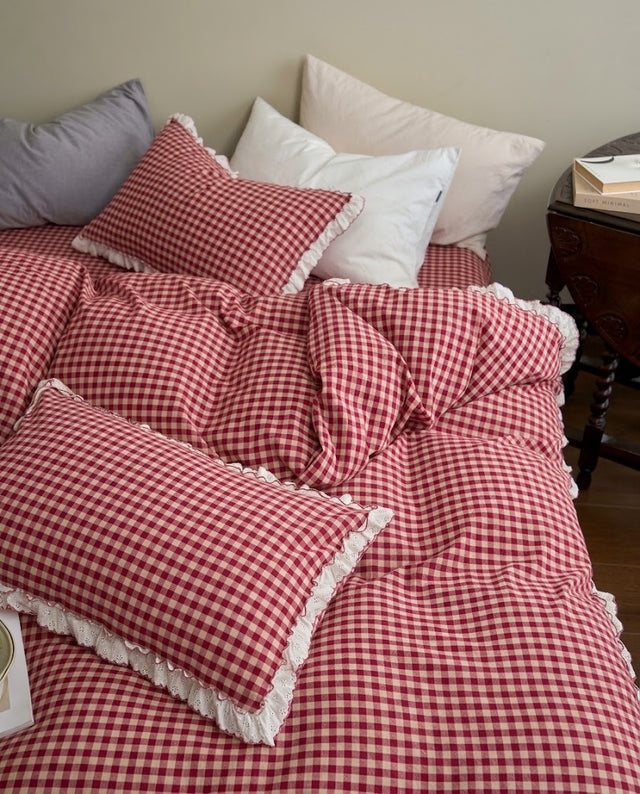
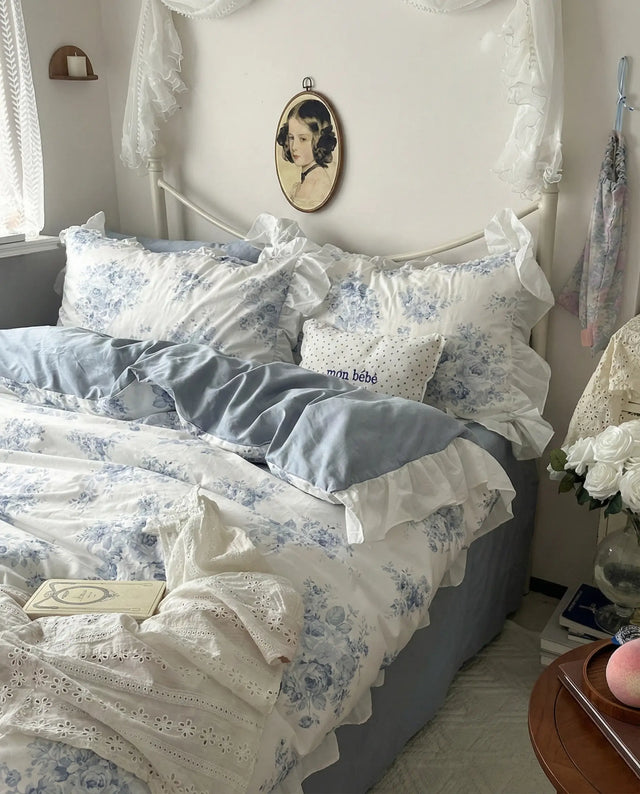
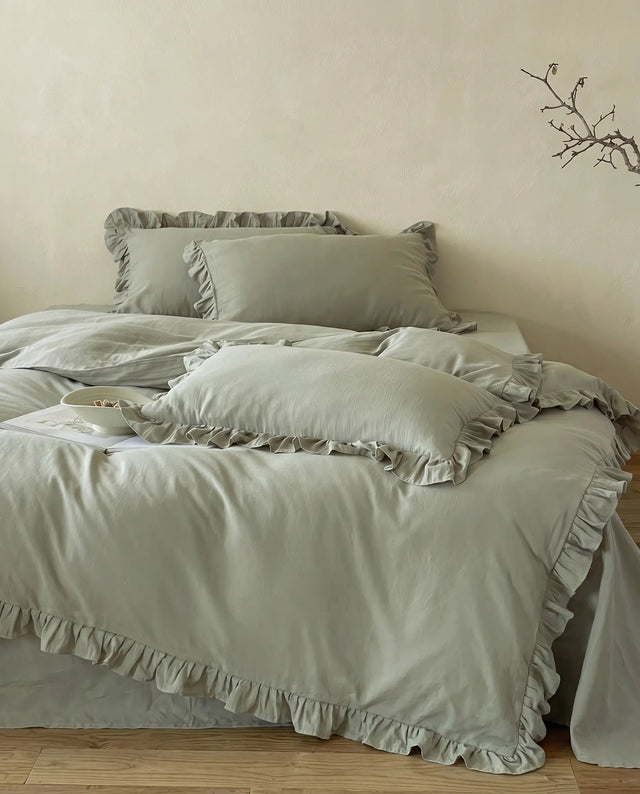
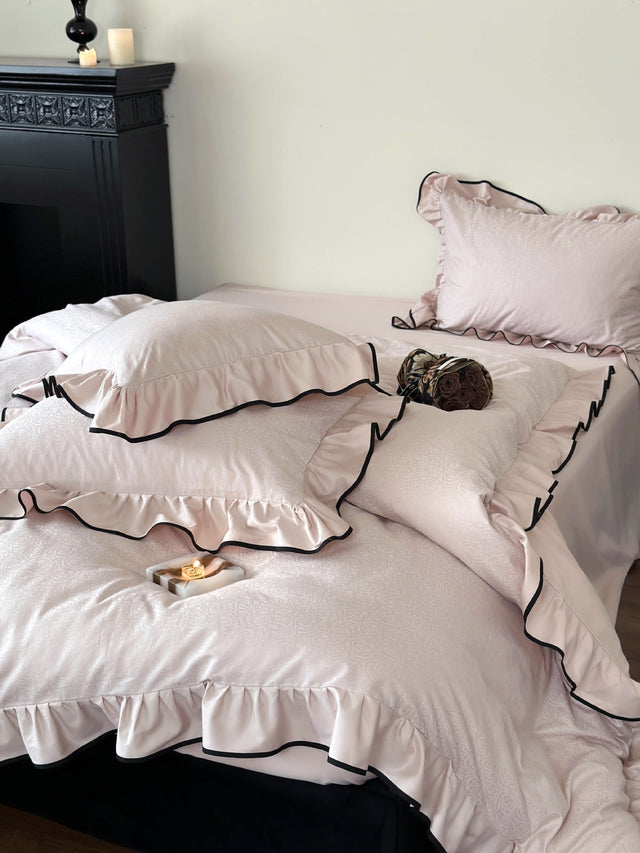
Ruffles are strips of fabric gathered along one side and sewn onto an edge, so they flare out and add volume. On bedding, you'll find them around the border of the duvet cover and along the edges of the pillow shams. The middle of the cover stays flat, often with a print or embroidery.

Ruffles draw the eye to the outline of the bed and keep the centre calm, which makes them a natural match for prints. Our ruffled sets:
- The Rosalie Ruffle Duvet Cover Set has layered ruffle trim on a solid cover, in Eucalyptus Sage, Blush Pink, Mist Blue and Snow.
- The Blue Florals Ruffled Duvet Cover Set frames blue florals on ivory with a ruffle trim.
- The Embroidered Pink Floral Duvet Cover Set pairs pink floral embroidery with a lace ruffle trim.
- The Cherry Gingham Ruffles Duvet Cover Set finishes red gingham with white eyelet lace ruffles.

Ruched vs ruffled bedding at a glance
| Ruched | Ruffled | |
|---|---|---|
| Where the texture is | Across the whole cover | Along the edges of the cover and shams |
| Overall look | Soft, textured and dimensional | Framed, romantic and vintage-inspired |
| Works best with | Solid colors and neutral rooms | Prints, florals and color |
| Hides creases | Very well, the gathers disguise them | Less so, since the centre of the cover is flat |
| After washing | Smooth the gathers by hand | Shake out and straighten the edges |
Which one should you choose?
Choose ruched if
- You want texture without pattern.
- You love an all-white or neutral bed.
- You'd rather not spend time smoothing the bed every morning.
Choose ruffled if
- You love prints, florals or color.
- You want the bed to feel romantic or vintage-inspired.
- The rest of your room is fairly simple and you want the bed to be the focal point.
Still deciding? Look at the rest of the room. If the walls, rug or curtains already have a lot of pattern, ruching adds texture without adding more. A simpler room can carry the extra personality of a printed ruffled set.
Can you mix ruched and ruffled bedding?
Yes. The Royal Ruched set already combines both, with a ruched duvet cover and a ruffled bed skirt. If you're mixing your own pieces, keep the colors in the same family, like white with ivory or blush with cream, so the two textures work together instead of competing.
Caring for ruched and ruffled bedding
Both are easy to care for. Wash cold on a gentle cycle with a mild liquid detergent, skip the bleach, and tumble dry on low or air dry. The only difference is the finishing touch: smooth ruching by hand while it's still slightly damp, and give ruffles a firm shake and straighten the edges before they dry. Always check the care label on your set first.
For step-by-step tips, see our guide on how to wash ruched bedding.
Make it a complete bed
Whichever style you choose, add the Organic Soybean Fiber Duvet Insert to any duvet cover set and the insert is 20% off with Bundle & Save. Browse our ruched bedding and ruffled bedding collections to compare them side by side.